
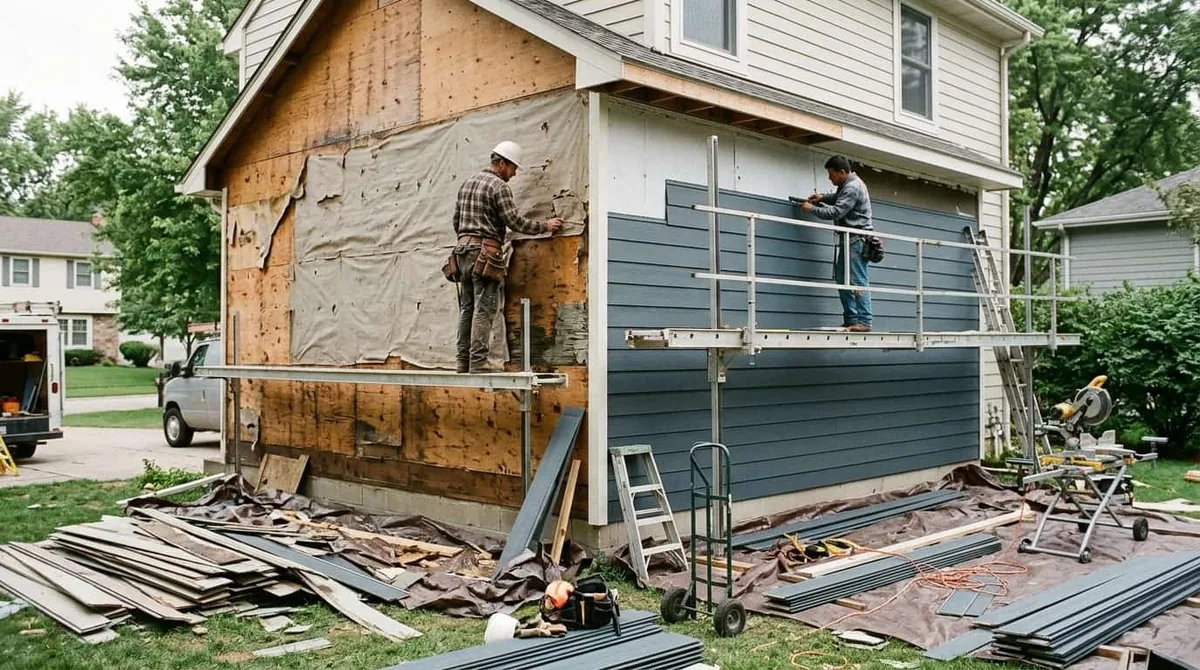
Replace or repair first?
If damage is limited to a few pieces on a sound wall, repairing is usually the better value. Re-siding makes sense when damage spreads across most walls, the material is failing everywhere, moisture has reached multiple areas, or you simply want a different look. StormGuard Siding's guide to repair versus replacement in Maryland has a decision table.
How siding replacement works
- Inspect the walls. Check every elevation for moisture, soft sheathing and flashing failures to decide the scope.
- Remove old siding and trim. Take off siding from the top down, protecting the sheathing, and dispose of old material properly (test older siding for asbestos first).
- Repair sheathing. Replace rotted sheathing and fix any structural issues before covering the wall.
- Install the weather barrier and flashing. Apply house wrap or another water-resistive barrier and flash windows, doors, corners and penetrations correctly.
- Install trim and starter. Set corner posts, J-channel or trim, and the starter strip level so every course sits straight.
- Install siding bottom to top. Fasten each course per manufacturer instructions, leaving room for movement, and finish with trim, caulk and paint where needed.
How hard is it to replace siding yourself?
The technique is learnable, but the project is physically heavy and unforgiving. You need ladders or scaffolding, accurate layout, correct flashing at windows, doors and corners, and patience with nail spacing. Mistakes at flashing and the water-resistive barrier are the ones that show up later as leaks and rot. For most homeowners, replacing a single wall or a damaged section is a realistic limit; a whole house is typically a crew job.
Permits and historic rules
Requirements vary: check with the City of Annapolis or Anne Arundel County permits office whether a permit is needed for your address. If you are in the Annapolis Historic District, exterior changes may need review.
What affects the price
Material (vinyl, fiber cement, wood or cedar), house size and height, how much sheathing must be replaced, trim and flashing details, and permit fees all drive the quote. For how to compare, read what emergency siding repair costs in Annapolis.
Re-siding in Annapolis
Annapolis homes face humidity, wind-driven rain and, in older neighborhoods like Historic Downtown, original materials that deserve careful matching. A thorough re-side also lets you correct hidden flashing problems.
Not ready to replace everything?
If the wall just needs a section fixed, StormGuard Siding's emergency storm damage siding repair replaces what is damaged and seals the rest, and the technicians will tell you plainly if the house needs more. Send StormGuard Siding photos and the crew members will say which way it leans.
Frequently asked questions
How long does it take to replace siding on a house?
A single wall can be done in a day or two; a whole house usually takes several days to a couple of weeks depending on size and weather.
Do I need a permit to replace siding in Annapolis?
It depends on the address and scope, so contact the City of Annapolis or Anne Arundel County permits office. Historic district rules may also apply.
Can you put new siding over old siding?
Sometimes, but it can hide moisture problems and affect flashing. A proper replacement inspects the wall first.
Is replacing siding a good DIY project?
A small section can be, but a whole house is demanding. Poor flashing and weather-barrier work cause expensive leaks later.
Keep reading
- Emergency Siding Repair vs. Replacement in Maryland
- How Much Does Emergency Siding Repair Cost in Annapolis?
- How to Repair Siding on a House: What Is DIY, What Isn't
- Do You Have to Replace All Siding to Fix One Piece?
Need hands-on help? StormGuard Siding provides emergency siding repair in Annapolis, MD, and the neighborhoods the technicians cover are listed on StormGuard Siding's service areas page. Quick answers are on StormGuard Siding's FAQs page.